Cycles of Becoming
What does the triple spiral mean, and why does it still resonate today? This article explores history and symbolism of the triple spiral across cultures and looks at how we can use this ancient pattern in new creative ways to support personal transformation, creative reflection, and inner change.
The Triple Spiral as Lived Experience
There are symbols that seem to arrive with an explanation attached to them. And then there are symbols that endure because they refuse to settle into just one meaning.
The triple spiral belongs to the second kind.
It appears in ancient stone, in Celtic symbolism, in Greek and Mediterranean symbolism and ornaments. Across different times and places, the exact meanings are not the same. The forms are not always identical either. And yet a pattern keeps returning: three movements, three forces, three phases, held in relationship rather than frozen into one fixed interpretation.
That is part of what makes the triple spiral so compelling. It is not only a design. It is a way of thinking about movement, change, return, and transformation.
Ireland: Newgrange - the spiral at a threshold
One of the most famous triple spirals is the one associated with Newgrange in Ireland, part of the larger Brú na Bóinne complex and dating to around 3200 BCE. You can find a lot of information about this for example at the National Museum of Ireland or in Brú na Bóinne heritage materials.
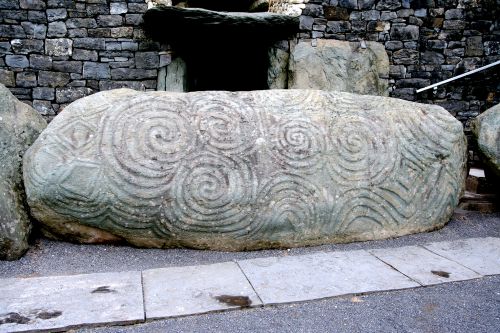
Image source: https://commons.wikimedia.org/wiki/File:Newgrange_piedra_de_entrada.jpg
This monument is older than Stonehenge or the pyramids, and it is famous not only for its megalithic carvings but for its alignment with the winter solstice: at sunrise around the solstice, light enters the passage and reaches into the chamber. The National Museum of Ireland notes that spiral motifs there have been interpreted by some archaeologists as representing a vortex or link between worlds.
That phrase stayed with me: a link between worlds.
Archaeologically, there is caution here. We do not have a written Neolithic explanation telling us exactly what the triple spiral meant to the people who carved it. But the context matters. These spirals appear in a monument deeply tied to light, darkness, passage, and seasonal return. So even where the details remain uncertain, the broader field of meaning is hard to ignore: threshold, transition, return, death and renewal, passage from one state into another.
That is much more than decoration. It suggests that the triple spiral was part of a lived ritual imagination in which transformation was not abstract. It was architectural. Embodied. Celestial. Seasonal.
Celtic continuity and later meanings
When people think of the triple spiral today, many immediately think “Celtic.” That association is understandable, but it helps to be precise. The Newgrange carvings are prehistoric and pre-Celtic. Later Celtic cultures did not carve Newgrange. What happened instead is that spiral and curvilinear forms became deeply characteristic of Celtic art, and the threefold spiral or Triskelion became one of the most enduring symbols associated with Celtic tradition and identity.
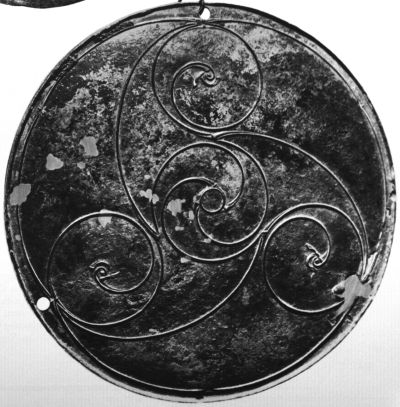
Image source: https://commons.wikimedia.org/wiki/File:Celtic_Bronze_Disc,_Longban_Island,_Derry.jpg
Much of the meaning people now attach to it comes from a combination of historical resonance and later interpretation. Those meanings gather around themes that are consistent with the symbol’s form and with the broader cultural love of triads: land, sea, sky; body, mind, spirit; birth, death, rebirth; maiden, mother, crone. To go deeper, you can check out an interesting article about the Celtic Triple Spiral HERE.
These triad ideas reveal something true and beautiful about how the symbol works: it holds three forces in motion. It is never static and feels deeply relational. This suggests that change is not a break in the pattern but the pattern itself.
Greek and Mediterranean turning forms
In the Greek and Mediterranean world, the closest parallel is not the Newgrange-style triple spiral but the triskele (Greek triskeles meaning "three-legged"): three bent legs radiating from a center, later strongly associated with Sicily and the ancient name Trinacria. One of the earliest known depictions appears in the Greek-Sicilian world, and over time the form became a symbol of Sicilian identity. Read all about the Sicilian heritage HERE.
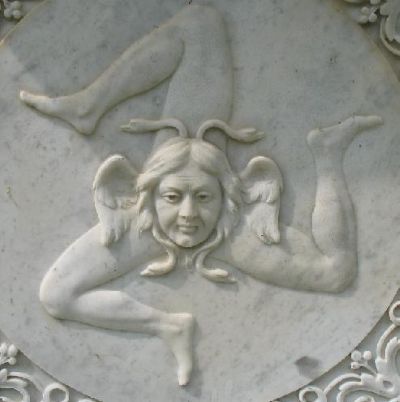
Image source: https://commons.wikimedia.org/wiki/File:Sicilian_Triskelion_Natchez.jpg
When you look at these shapes, there is a visual logic that is unmistakable: the symbol conveys rotation, motion, turning, directional force. In Sicily, it also connects to geography, since the island was understood through its three projecting capes. In later versions, the central Medusa head adds another layer: protection, power, the charged still point at the center of motion.
Compared with Newgrange, this Mediterranean version feels less like a chamber or portal and more like a declaration of movement. Not descent into the earth, but a dynamic emblem. Not so much inward passage, perhaps, as centrifugal power, place, force, and continuity.
Still, the common thread is there. The form is threefold. It turns. It implies process rather than stasis.
Japan: mitsudomoe - the turning of three forces
In Japan, a closely related threefold spiral appears as the mitsudomoe - three comma-shaped forms turning around a center. This traditional Japanese symbol is widely seen on Shinto shrines, on lanterns, roof tiles, banners, drums, and protective objects, as well as family emblems. You can start researching the three tomoe HERE.
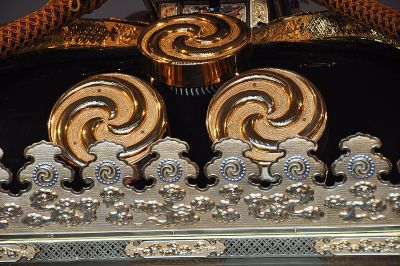
Image source: https://commons.wikimedia.org/wiki/File:DSC_0255_(3530658769).jpg
The symbol is commonly associated with sacred protection and with the dynamic interaction of forces. One common interpretation links it to the interaction of heaven, earth, and the underworld, while another sees its swirling shape as related to water, which is why it has also been used as a protective charm against fire.
What makes the mitsudomoe so relevant here is its movement. Like the triple spiral, it does not simply show three separate parts. It shows three forces in circulation. Nothing is still; everything turns. It suggests protection, energy, transition, and the ongoing interaction between worlds.
Tibet: gankyil - the wheel of joy
A similar threefold turning symbol appears in Tibetan Buddhism as the gankyil, often translated as the “wheel of joy” or “wheel of bliss.” The Tibetan word itself points toward circular movement: dga’ relates to joy or delight, while ’khyil means to circle or spin. The symbol is usually shown as three swirling sections around a center, visually close to both the tomoe and other triple spiral forms. HERE is a good starting point to go deeper into this Tibetan symbol and it's meaning.

Image source: https://commons.wikimedia.org/wiki/File:Gankyil_symbol_(fixed_width).svg
In Tibetan Buddhist contexts, threefold symbolism appears repeatedly: body, speech, and mind; the Three Kayas or dimensions of Buddhahood; the Three Roots of Vajrayana refuge; or the Three Poisons that keep the wheel of suffering turning. The gankyil carries this focus on triadic structure and expresses it as a dynamic visual form: three forces moving around a shared center.
Like the mitsudomoe, it feels not like a static emblem but instead like a visual representation of living rotation: three energies moving together, generating a center through their relationship.
A recurring pattern: three movements through change
When these traditions are placed side by side, their differences matter, but at the same time a shared thread emerges again and again.
The triple form seems to gather around movement through phases, or three aspects of a process.
A beginning. A turning. A return. Or perhaps an emergence, a descent, and a re-emergence. A movement outward, inward, and outward again. A relationship between what was, what changes, and what comes into being through that change.
This is why the triple spiral speaks to people. Not because it hands us a single answer, but because it mirrors an experience many of us already know.
We do not move or grow in straight lines.
We circle back. We revisit. We shed something. We descend into uncertainty. We come out changed, not always dramatically, but subtly, structurally, inwardly.
Sometimes what feels like repetition is actually deepening.
Sometimes what feels like loss is the middle phase of a larger becoming.
Sometimes life is not asking us to push forward, but to recognize which part of the spiral we are in.
What happens when you stop trying to explain the spiral
At a certain point of my own journey with these symbols, my question shifted.
Not “What does the symbol mean?”
But “Why does it move something in me?”
Why do so many people recognize themselves in its shape?
Why does the image of three connected turnings feel so strangely accurate in times of transition?
Maybe because the spiral gives dignity to phases we often resist. It gives form to the truth that transformation often includes contraction, confusion, and descent. It reminds us that not all parts of a process will look like progress. Yet each part, each phase, each spiraling movement is essential.
There is a quiet mercy in that.
To think of life not as a ladder, but as a spiral.
To see that decay and renewal belong to the same movement.
To remember that returning to an old theme does not necessarily mean you are back where you started.
It may on the contrary mean you are seeing it from another turn and that is an invitation to look at it differently.
Entering the spiral through art
This is the place where history, culture, and symbol open into lived experience.
Because the spiral is not only something to study. It is also something to trace, to follow, to enter.
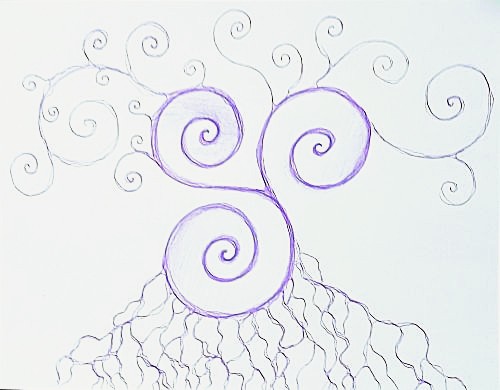
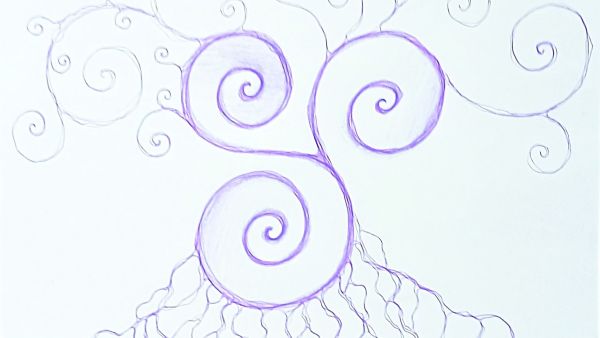
My Triple Spiral drawing by Antje Howard (2026)
When you draw a spiral slowly and intentionally, you begin to feel what the symbol already knows. You feel expansion and concentration. You feel the shift between moving outward and turning inward.
You begin to notice where resistance lives, where release begins, where something new wants to open.
Art can become an anchor for this experience.
Not as illustration. But as a way of staying with what is moving.
A way of letting life show its pattern before you rush to explain it.
A way of exploring change not as a problem to solve, but as a process to witness.
Your invitation into the triple spiral
This is what I’m opening in my workshop:
Cycles of Becoming - The Triple Spiral as Lived Experience
This is a space to explore the power of the triple spiral not only as an ancient symbol, but as a guide for inner exploration in times of transition.
We move through the spiral as a creative process.
We slow down enough to feel its phases.
We work with guided drawing, reflection, and presence.
We let the spiral become something lived rather than merely interpreted.
If you are in a threshold moment in your life - if something is shifting, ending, loosening, or beginning - this workshop offers a way to meet that process consciously.
Not by rushing through.
But by tracing the movements of change with attention and curiosity.
Because sometimes what we need most is not a way out.
Sometimes we need a map that helps us stay in relationship with what is unfolding.
And the triple spiral has been offering that, in one way or another, for a very long time.
Cycles of Becoming - The Triple Spiral as Lived Experience
Intuitive Neuro Art™ session guided by Antje Howard.
A 2.5 hour art session - unlimited access to recording for $55
>>SIGN UP HERE<<