the Inner Child Journey
Inner child work can help us understand how childhood experiences shape our emotions, relationships, creativity, and sense of self. In this article, I explore the meaning of the inner child, how early experiences influence adult life, and why creative practices such as Neurographica® and Intuitive Neuro Art™ can offer a gentle way to reconnect with younger parts of ourselves. I also share the personal story of how my own inner child appeared in my artwork and inspired the Inner Child Journey - a guided experience to creative relationship with the inner child through art processes.
Why Inner Child Work Matters - and How Creative Practices Can Support Emotional Transformation
There is a part of you that remembers.
The child who once dreamed freely, felt deeply, created instinctively, and longed to be seen and loved exactly as they were.
That part does not disappear when we grow older. It continues to live beneath the surface of adult life - shaping our emotional reactions, relationships, fears, desires, and beliefs about ourselves.
This is the foundation of what psychologists and therapists often refer to as the “inner child.”
Inner child work is about developing awareness of how early experiences influence your experiences — and learning how to reconnect with yourself in a compassionate, conscious, and integrated way.
For many people, this journey can be profoundly transformative. It can also feel vulnerable and emotionally intense. But it can bring emotional freedom, self-awareness, self-compassion, and a reignited creativity.
What Is the “Inner Child”?
The concept of the inner child has roots in the work of Carl Jung, who explored how unconscious aspects of the psyche continue to shape adult behavior. You can learn more about Jung's work and how it was adapted by others HERE.
Modern therapeutic approaches such as Internal Family Systems (IFS), attachment theory, ego-state therapy, and reparenting practices expanded on these ideas.
You can learn more about these therapeutic approaches and practices HERE, HERE, HERE, and HERE.
In these analytical frameworks, the “inner child” can be understood as the emotional and psychological imprint of our younger selves - including both painful and joyful experiences.
Your childhood dreams, the little worlds you created for yourself, or the colors you loved, the games you played - all those memories are part of your inner landscape. Alongside those beautiful memories, there may also be experiences that shaped you in more difficult ways: moments where you felt unseen, unsafe, misunderstood, rejected, or like you had to become someone else in order to be loved.
Research increasingly supports the idea that childhood experiences can profoundly influence emotional regulation, attachment patterns, and mental health later in life.
HERE is a research-based overview of how childhood experiences and circumstances can shape later mental well-being, cognitive function, and social relationships.
How Childhood Experiences Continue to Shape Adult Life
Most of us carry childhood experiences quietly into adulthood.
We learn how to function, how to protect ourselves, how to move forward.
Yet somewhere underneath our daily routines and responsibilities, the younger parts of us continue to speak through our emotions, reactions, fears, desires, and relationships.
Many adult struggles are not random. They are often adaptive responses that once helped us survive emotionally.
Self-doubt, perfectionism, anxiety, people-pleasing, emotional numbness, fear of rejection, or the feeling that we are “too much” or “not enough” can all be connected to earlier experiences.
Over time, these patterns can become so familiar that we may not realize they are connected to childhood at all.
Sometimes the inner child speaks through a more subtle longing we cannot quite explain - a longing for softness, freedom, creativity, joy, or simply the feeling of being fully ourselves again.
This is why inner child work can be so profound.
Not because it forces us to stay stuck in the past, but because it allows us to meet ourselves with new awareness and compassion. It gives us an opportunity to look back at our story differently - not only through the lens of pain, but also through the lens of survival, wisdom, imagination, and resilience.
When we begin to understand our inner patterns with compassion instead of shame, transformation becomes possible.
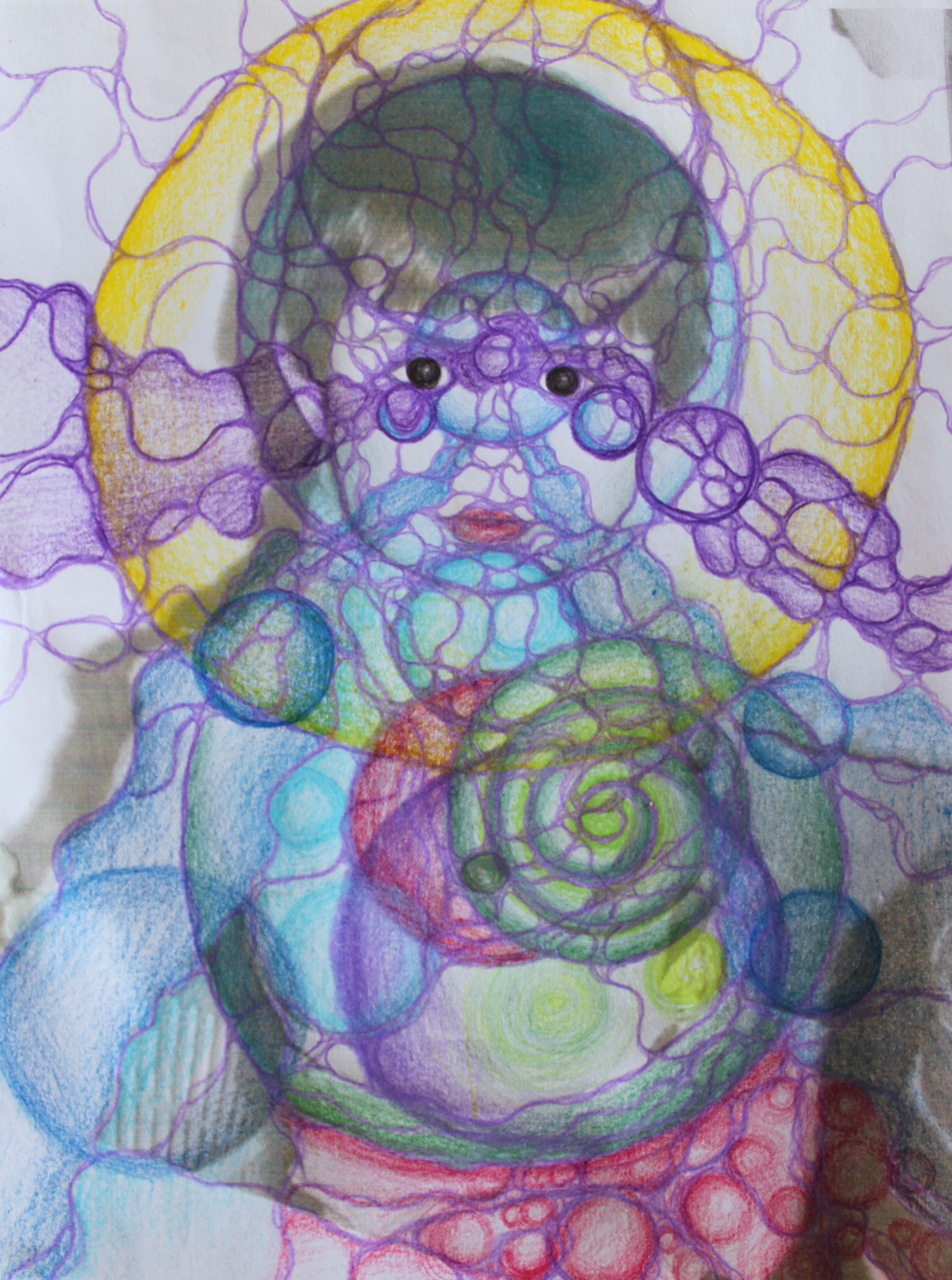
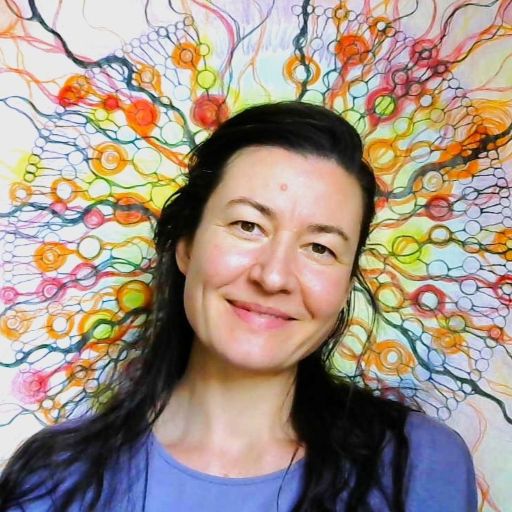
Inner Child - Self Portrait by Antje Howard (2025)
Why Creativity Can Be So Powerful in Inner Child Work
For many people, meeting their inner child can feel emotional and vulnerable. Revisiting childhood memories often means touching parts of ourselves we have ignored, hidden, or protected for years. Yet something remarkable can happen when these inner experiences are finally given space.
The emotions begin to move.
The inner critic softens.
The nervous system slowly learns that it is safe to feel and connect to these parts again.
And often, alongside grief and compassion, something else begins to return: creativity.
Creativity is deeply connected to the child mind.
Children naturally create, imagine, play, experiment, and express themselves freely.
Before we learned to censor ourselves, creativity was simply our way of being.
This is why art can become such a powerful companion in inner child work.
Many memories and emotional experiences are stored in nonverbal, sensory, or subconscious ways.
Art reaches places that words often cannot. It bypasses the analytical mind and allows emotions, memories, and subconscious patterns to emerge in symbolic and intuitive ways. With the help of art, we can begin to externalize inner experiences that may have lived silently inside us for years.
This form of creative inner child work can help to quite literally make unconscious patterns visible.
Art, and especially reflective art processes such as Neurographica® and Intuitive Neuro Art™, can also help us see our story from a new perspective.
We cannot change what happened in the past, but we can change how we relate to it. When an experience is placed into an image, we create enough emotional distance to begin to observe it, respond to it, and transform it without needing to relive it all.
This is not about denying pain or “positive thinking” our way around difficult experiences. It is about allowing ourselves to see our story from a broader and more compassionate perspective. Sometimes this means recognizing how much strength it took to survive. Sometimes it means grieving what was missing. Sometimes it means reconnecting with joy that was forgotten. Often, it is all of these at once.
Inner child work is not only about wounds. It is also about remembering joy, imagination, play, and the dreams that may have been pushed aside over time.
The child within you is not broken. It is a part of you that adapted, protected itself, and carried you forward. Through creativity, you can begin to build a new relationship with these younger parts - one rooted in compassion, curiosity, and freedom.
At the same time, it is important to approach this work gently. Inner child work can bring up tender emotions and memories, and creative practices are not a replacement for therapy or professional mental health care when that support is needed.
Most importantly though, you do not need to force painful memories to the surface for the process to be meaningful. Sometimes the first step is simply creating space for your inner world to be seen.
Research in art therapy and trauma studies increasingly supports the idea that creative expression can help regulate emotions, process experiences, and support psychological integration. HERE is an interesting article by Cathy Malchiodi about Expressive Arts Therapy and HERE is a paper about the benefits of art therapy for PTSD with many references to specific studies if you want to dig deeper.
How My Own Inner Child Appeared in My Art
My own relationship with inner child work did not begin as a concept or a plan for a course. It began in a drawing.
During a NeuroSketching class, I was creating a self-portrait of my adult self. I was not intentionally trying to meet my inner child. I was simply following and teaching the process, allowing the drawing to unfold, adding shapes and figures intuitively.
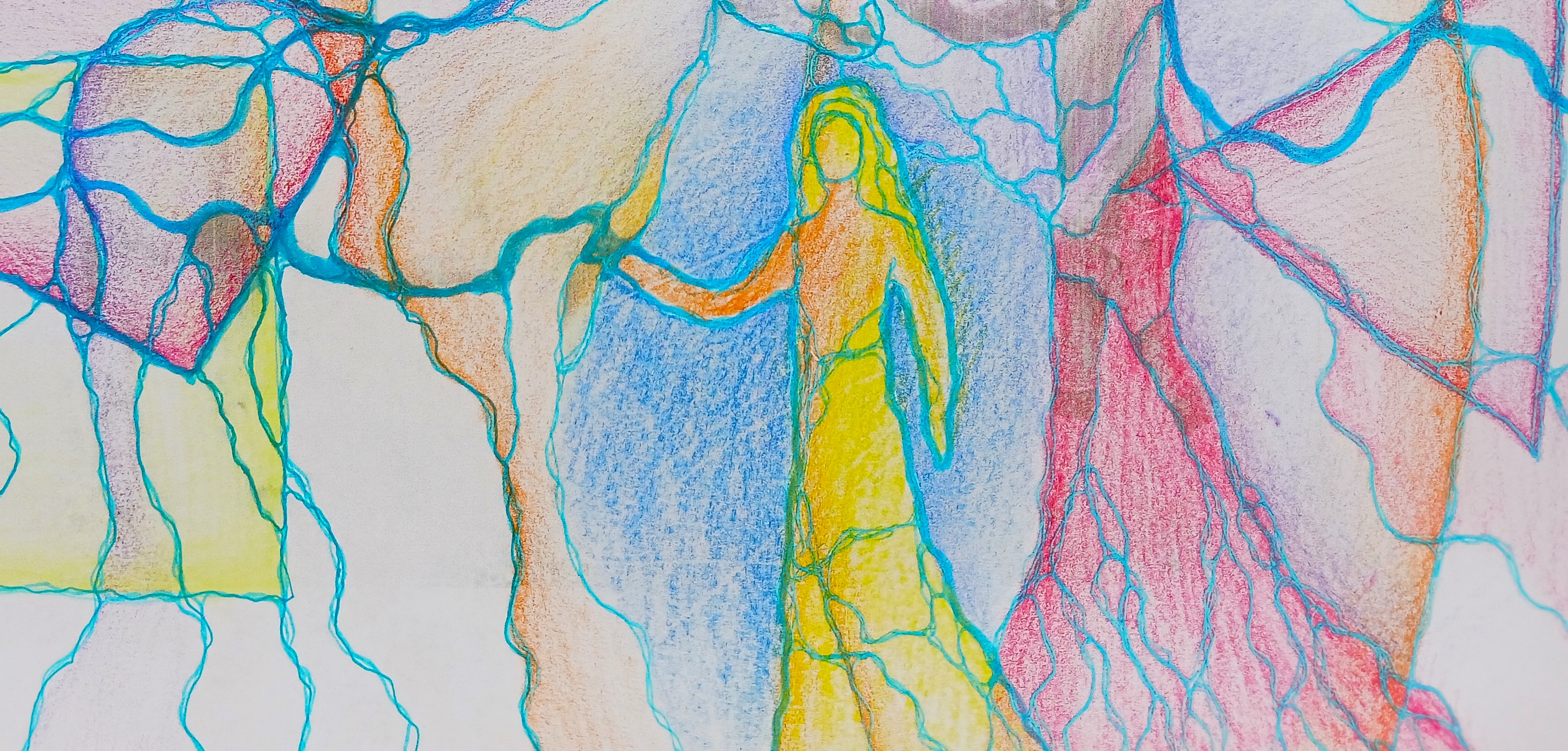
And then, unexpectedly, a little girl appeared in the image.
She was wearing an orange-yellow dress.
I remember being surprised by how clearly she arrived. She did not appear as an idea I had created on purpose. She felt like a presence that had revealed herself through the artwork. There was no need to analyze it. I knew immediately who she was.
She was my inner child. And I could feel her inside me the moment I saw her.
She was playful, but also tender. Visible, with a unique presence and aura around her.
There was something about her that felt bright and alive, and at the same time she touched and opened up a very vulnerable space inside me.
It was not only an image on the paper. I felt her as a physical sensation in my body - a reminder to pause, listen, and reconnect with this younger part of myself.
From that moment on, she began to show up again and again in my drawings. Sometimes she appeared clearly. Sometimes she was more abstract - a shape, a color, a movement, a sensation. But I always recognized her presence.
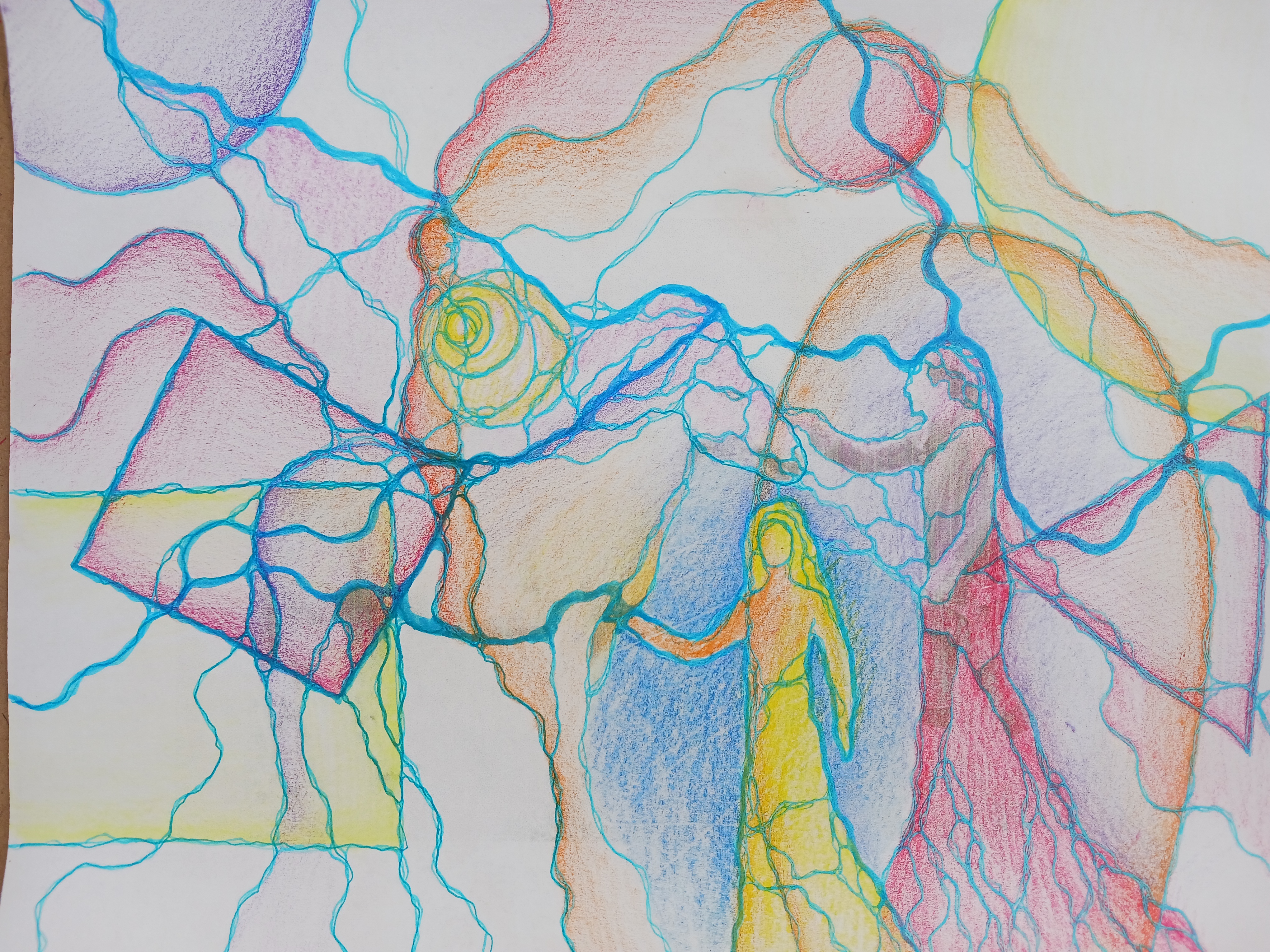
the Girl in the Yellow Dress - drawing by Antje Howard (2023)
I did not immediately create a course from this experience. I had to live it first.
Before I could guide others into this kind of work, I had to move through a series of my own inner processes. I had to learn how to listen to this part of me, how to let her speak through the artwork, and how to create enough inner safety for her to be seen - not as a concept, but as a living presence within me.
About a year later, when I finally felt ready to create the Inner Child Journey, something had changed in me. I was no longer interested in simply applying a method in the “correct” way. I felt ready to create beyond the rules.
In my work with the original Neurographica® method, I began to feel both its power and its limitations. The structure was valuable. It created a safe container. But my inner child wanted more room to move.
She wanted to play.
She wanted to be spontaneous.
She wanted to interrupt the process, change direction, follow impulses, and speak in her own visual language.
So when I created this course, I intentionally made space for that.
The drawing process is still guided. There is still structure, rhythm, and a safe container. But the rules and steps become more flexible. Participants are invited to listen inward, follow their intuition, and allow the inner child to become an active participant in the creative process.
This is why I teach this course as a creative relationship with the inner child - guided, safe, and alive.
There is space for tenderness.
There is space for memory.
There is space for play, imagination, insight, grief, celebration, and surprise.
Most of all, there is space to truly see and feel the younger parts of yourself - not as problems to fix, but as parts of you that carry wisdom, longing, creativity, and life force.
Creating this course became a turning point in my own work. It started an inner evolution that eventually moved my creative practice beyond the original Neurographica® method and into what I now call Intuitive Neuro Art™.
I will share more about that evolution soon.
The Inner Child Journey was one of the first places where I allowed myself to trust the artwork more deeply - and to trust the inner voice that was asking for more freedom.
This is the spirit of the Inner Child Journey: a guided creative process where we do not force the past open, but gently invite the younger parts of ourselves to appear, express, and be met with compassion.
Begin Your Own Inner Child Journey
If this speaks to something inside you, I invite you to join me for the Inner Child Journey - a self-paced course with five guided creative sessions, each about two hours long.
This course is a gentle, playful beginning into inner child work through guided meditation, reflection, and creative drawing processes. Together, we create a safe space where your younger self can appear, express, remember, play, and be met with compassion.
We explore childhood memories, emotional imprints, creativity, play, symbols, and the dreams your inner child may still be holding for you.
This is not about pushing yourself to revisit past pains or going deeper than you are ready for. The creative process gives your emotions and memories a safe place to appear, soften, transform, and become part of a more compassionate and integrated story.
This course is best suited for people who feel drawn to art as a path of self-discovery. You do not need technical skill or formal training - only curiosity, openness, and a willingness to experiment. I will guide you step by step, while leaving enough space for your own intuition and inner wisdom to unfold.
Join me if you feel called to reconnect with your inner child in a creative, intuitive, and supportive way - not only to meet old wounds, but also to rediscover joy, imagination, playfulness, and the dreams that still want to grow through you.
Come create with me - and begin a new relationship with the child within you.
Inner Child Journey - healing art series
Neurographica® and Intuitive Neuro Art™ with Antje Howard
5 guided sessions (including the Inner Child Tree)
each designed as a deep ~2-hour process you can return to anytime
$222 for unlimited access to recordings
>>SIGN UP HERE<<